
What Is a Lip Flip? Everything to Know Before You Book
By Gaby
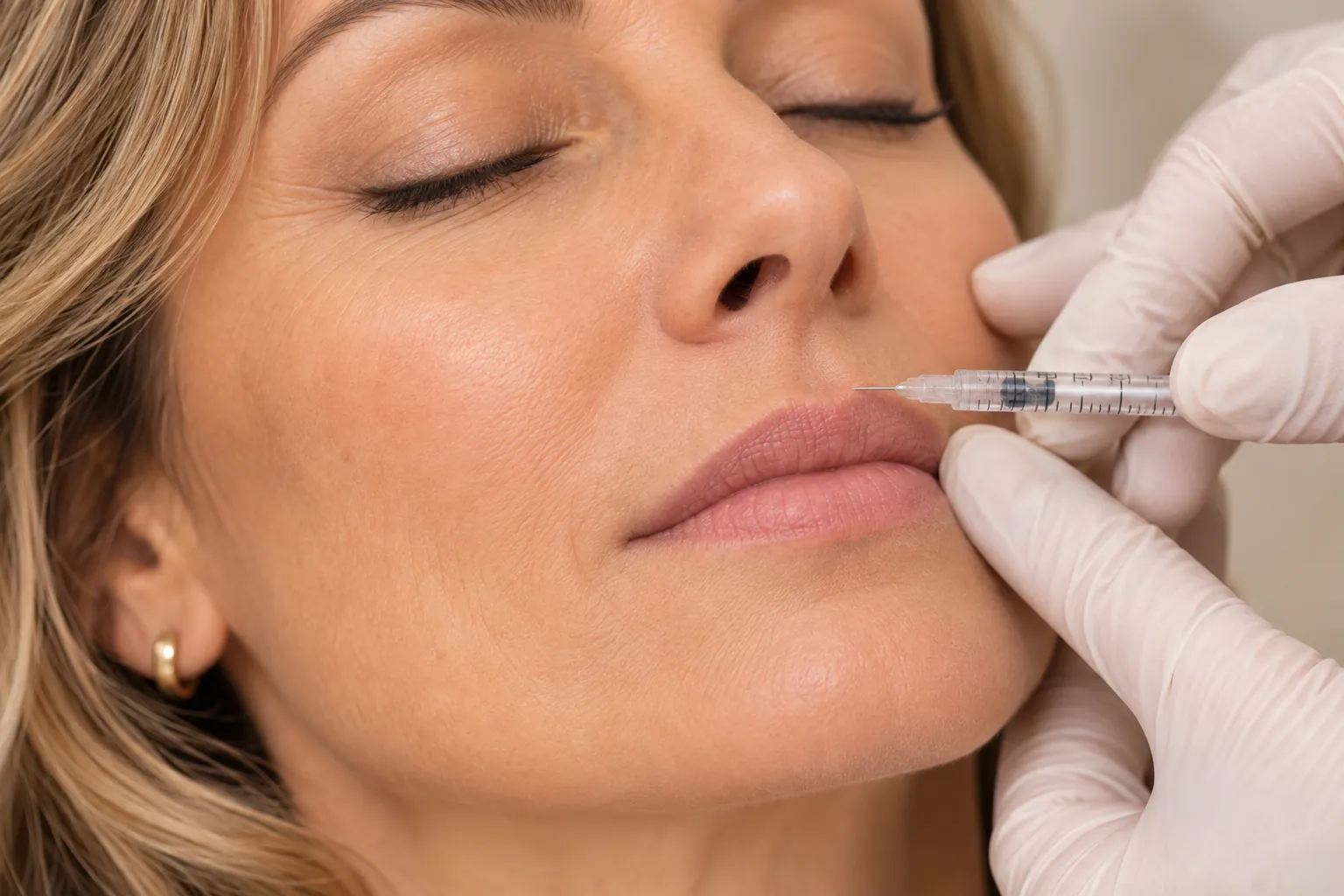
If you've been looking at lip photos and wondering how someone got a fuller-looking upper lip without that "filled" look, there's a good chance the answer is a lip flip. It's one of the smallest, quickest treatments in aesthetics, and one of the most misunderstood. So let's walk through it properly: what it is, what it actually does to your lip, and how to know if it's right for you.
What is a lip flip, in plain words?
A lip flip is a treatment where a provider injects a very small amount of a neuromodulator (the family of products that includes Botox, Dysport, Xeomin, Jeuveau and Daxxify) into the muscle along the border of your upper lip.
That muscle is called the orbicularis oris. It circles your mouth like a drawstring, and it's what you use to pucker, sip, whistle and kiss. When it's very active, it tends to pull the upper lip inward and "tuck" some of the pink part of your lip under.
A few tiny injections relax the edge of that muscle. The upper lip then rolls very slightly up and out, so more of the pink part (called the vermilion) shows. Nothing is added to the lip. You're simply seeing more of the lip you already have.
That's where the name comes from: the lip "flips" outward a little.
What does a lip flip actually do?
Here's what most people notice once it settles in:
- The upper lip looks a bit fuller, especially from the front and in photos
- The top lip shows more pink when you smile
- The Cupid's bow can look a little more defined
- For some people, less gum shows when they smile (more on that below)
- Lines above the lip can look softer, because the muscle isn't puckering as hard
And here's what it doesn't do:
- It doesn't add volume. If your lips are naturally very thin, a flip shows more of what's there, but it can't create lip that isn't there.
- It doesn't change the lower lip much. The flip is mostly an upper-lip treatment.
- It isn't permanent. The muscle wakes up again over time.
If you want real added volume, shape, or a plumper lower lip, that's the job of lip filler, which is a different treatment. Some people do both. You can read more in our FAQ.
How a lip flip is done
The appointment itself is quick. Here's what usually happens:
- A short consultation. Your provider looks at your lips at rest and while you talk and smile, and asks what you'd like to change.
- Cleansing and (sometimes) numbing. Many people skip numbing cream because the needle is very fine and the injections take seconds. Ice is common.
- A few small injections. Usually two to four points along the upper lip border, sometimes a couple near the corners.
- You're done. The injecting itself often takes less than five minutes. Most people go straight back to their day.
The dose is small. Providers commonly use somewhere around 4 to 8 units of Botox (or the equivalent amount of another brand) for a lip flip, compared with 20 or more for the forehead frown lines. Your provider will choose the amount based on your muscle strength and the look you want. Starting low is normal, because you can always add a little more at a follow-up but you can't take it away.
When will I see results?
A lip flip is not instant. The product needs time to calm the muscle down.
- Days 2 to 5: you may start to notice a subtle change
- Around day 10 to 14: you'll see the full effect
This is why a good provider will often ask you to come back around the two-week mark if you want to check in or adjust.
How long does a lip flip last?
Most lip flips last about 6 to 12 weeks, often around 2 to 3 months. That's shorter than Botox in the forehead, and there's a simple reason: the mouth never really stops moving. You talk, eat, drink and smile all day, so the muscle works its way back to full strength faster.
A few things can affect how long yours lasts: your metabolism, how strong the muscle is, how much was used, and how expressive you are. People often find a rhythm of coming back every two to three months if they love the look.
Does a lip flip hurt?
Most people describe it as a few quick pinches. The lip is sensitive, so it's not nothing, but the needle is tiny and there are only a few injection points. Ice before and after helps.
Is there any downtime?
Very little. You may see a small bump or pinprick at each spot that settles within an hour or so, and occasionally a tiny bruise. Providers commonly ask you to:
- Stay upright for a few hours afterward
- Avoid rubbing or massaging your lips that day
- Skip hard workouts and alcohol for the rest of the day
Always follow your own provider's aftercare, since it can vary.
What does it feel like afterward?
This is the part people don't always hear about, so it's worth knowing ahead of time. Because the muscle that helps you purse your lips is relaxed, for the first week or two you may notice:
- Drinking through a straw takes more effort
- Whistling or blowing out candles feels harder
- Sounds like "p" and "b" feel a little different
- Your smile feels slightly different
These usually feel normal within a week or two as you get used to them. If you're a singer, a wind instrument player, or someone who talks for a living, mention it to your provider before treatment.
Who is a good candidate?
A lip flip tends to suit people who:
- Want a subtle, natural-looking change, not a dramatic one
- Have an upper lip that "disappears" or curls inward when they smile
- Show a lot of gum when they smile (a lip flip can help the upper lip cover a little more of it)
- Want to try a lip treatment for the first time without committing to filler
- Have soft vertical lines above the lip from puckering
It may not be the right fit if you want obvious volume, if your lips are very thin to begin with, or if you're pregnant or breastfeeding. People with certain nerve or muscle conditions, or who take certain medications, should talk it through with a medical provider first. Your provider should ask about your health history before treating you.
Why lips change as we age (and why so many of us start looking at a lip flip)
Most people who ask about a lip flip aren't trying to look like someone else. They're noticing that their own lips aren't quite what they used to be.
That's real, and it's not just in your head (MRI studies have actually measured it). With age, several layers under the lip change at once. Collagen in the skin thins, the small fat pads around the mouth shrink, the bone of the upper and lower jaw slowly loses volume, and teeth can shift. The upper lip tends to get longer and flatter, the pink part gets thinner, and fine lines appear above it.
Mayo Clinic dermatologist Dr. Saranya Wyles explained this beautifully on The Mel Robbins Podcast, comparing the face to a layered cake sitting on a platter: the skin layers are the cake, the muscle is the board underneath, and bone is the platter. When the platter shrinks, everything above it settles. We dig into that science in Your Face Is a Layer Cake: How Skin Ages, and Why Lips Lose Volume.
A lip flip can't rebuild those layers, but by relaxing the muscle that tucks the lip inward, it can bring back some of the lip you can no longer see. That's why it's such a popular first step for women in their 30s, 40s, 50s and beyond.
Lip flip vs. lip filler: a quick comparison
- What's used: a lip flip uses a neuromodulator such as Botox. Lip filler uses a gel, most often hyaluronic acid.
- What it does: a flip relaxes the muscle so more lip shows. Filler adds volume and shape.
- How it looks: a flip is subtle. Filler can be subtle or more noticeable, depending on the amount.
- How long it lasts: a flip lasts about 2 to 3 months. Filler often lasts 6 to 12 months.
- Cost: a flip is usually much less than a syringe of filler.
Some people choose one, some choose the other, and some combine them. A good injector will tell you honestly which one gets you closer to the look you want.
How much does a lip flip cost?
Prices vary by city and by provider. Many providers charge per unit of Botox, and since a flip uses only a few units, it's one of the more affordable aesthetic treatments. Some offer a flat lip flip price. Where providers publish their prices, we show them on their listing, so you can compare before you call.
How to choose the right provider
A lip flip is a small treatment, but the lips are a delicate area, and a few millimeters make a big difference. When you choose a provider, look for:
- A licensed medical injector. That may be a physician, nurse practitioner, physician assistant or registered nurse, depending on your state's rules.
- Real before-and-after photos of lips. Not just forehead or crow's feet work. You want to see their lip results and whether you like their style.
- Clear pricing. You should know whether you're paying per unit or a flat fee before you sit in the chair.
- A real consultation. They should look at your smile, ask what you want, and be willing to tell you if a flip isn't the best option for you.
- A follow-up plan. Ask whether a two-week check-in is included.
That's exactly why we built Lip Flip Finder. Every provider in our directory has been checked for lip treatments specifically, so you're not guessing. Find verified lip flip providers near you, and if you'd like a sneak peek of what a flip could look like on you, try the free Lip Flip Mirror.
The bottom line
A lip flip is a quick, low-commitment way to show a little more of your upper lip, soften the look of a gummy smile, and give your mouth a subtly fresher look. It won't add volume, and it won't last forever, but for many women it's the perfect first step, or the perfect "just a little something."
And if you love how it makes you feel? That's reason enough.
* Notice: this article is not medical advice. Please read our disclaimer.